
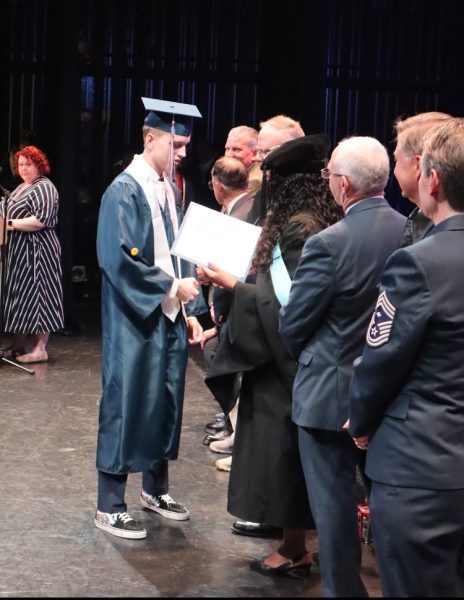
The class of 25 was full of many many cadets. Some had been here for six years, some only one, but they all went to UMA. And then, in May of 2025, they graduated. They worked hard on their hats and gowns and showed up to Perry’s Egyptian Theater. There–after the ceremonies, after the cheering, after all the times (good and bad)–they said goodbye.
Leaving high school doesn’t mean their lives are over, rather that they’re just beginning. They branched off, went across the state, across the country, some maybe even across the world. And now they’re in college, the military, working to explore the cosmos, and anything else you can think about. Leaving high school changes lives, but more importantly, it can change people.
To start, Landon Scharp was among the graduating Class of 25 earlier this year. But not much has changed for him. Though, he does miss high school, stating that “I miss hanging out with my friends.” But still, all the little things have balanced it out. Leaving high school behind gives you a lot of free time, which Scharp has spent playing games, watching movies, and living life. In the time away from school, he’s started making his own food, working on his driver’s licence, and just generally living his life however he wants.
Another graduate, Gabriel Brown, has traveled across the country, including Texas and Iowa, but for now, he’s ended up in Florida. He’s at the Florida Institute of Technology, studying Astrophysics and Astronomy. Even though his first choice was Embry Riddle Aeronautical University, he says he’s enjoying the FIT anyway. “It’s been great, I love it here! The campus is amazing and I love Melbourne Beach which is totally where I am.” Once he’s done with college, he plans to go to work at NASA with no particular job in mind. Just working at NASA is enough on its own.
Even though the future looks bright, former cadets are allowed to miss the past. Brown’s crowning piece of somberness comes from the JROTC program. He remarked that “I do miss the JROTC program itself. It’s given me lots of opportunities that I wouldn’t have had if I didn’t take it, and it’s allowed me to meet a lot of great people who have had a lot of influence on who I am today.” And yet, besides that, he didn’t think all that much of graduation: “There was 4 years of build up, and then it was kind of just anti-climactic.”
Brown leaves UMA with one last message to cadets: “Don’t place too much weight or mental strain on grades or scores or any of that superficial stuff. If you’re going to be stuck going to school for however many years you have left, focus on what matters to you. If you’re gonna be doing sports every day, do that, and enjoy it. If that’s all you like school for, then wake up every day to do sports. No job you can get will equal up to your own personal life. You need to do what’s right for you, and let yourself indulge in what you enjoy. You can have a billion dollars, but if you don’t know what to spend it on, then what’s the point? Go to school and just enjoy yourself. If you like a specific subject then just let yourself enjoy that without worrying about anything else. Go be a ninja.”
Jacob Parker had gone to UMA for 6 years before graduation, which made it hit so much harder. But, Parker also thought that, after all the buildup, it was a bit anti-climactic. Regardless, he’s moved on. Parker’s stayed in Utah, and now goes to Utah State University for their aviation program, and because it keeps him close to home. He says college has become “most of my life.” Still, USU is close to home for him, which gives him a chance to check back home every once in a while. After graduation from USU, Parker plans to become an aviator, eventually moving away, even though he doesn’t know where yet.
Though college is alright, Parker still misses a few things from UMA: The social circle, less to manage/less stress generally and less weight to decisions I make compared to now.” He also says that he’s “socially started over from scratch” in college. And, to end it off, his closing statement to cadets: “Don’t listen to what [Gabe Brown] said, try hard enough in school where your academics won’t majorly limit you if you ever choose one path over another, as well as it helps you build some sort of work ethic. Balance, do your best to enjoy life but don’t ignore academics either obviously.”
Though plenty of Cadets graduated last year, plenty more will graduate this year. And then their lives will be changed just like the Cadets before. And then on and on and on for as long as UMA goes. But, it’s important to look at each and every cadet who graduates, because one cadet could change the world.